Middle Eastern Union
Eight nations. One shared coastline.
The Middle Eastern Union is a political and economic union of eight sovereign states surrounding the Perso-Arabian Gulf. It was established by the Treaty of Muscat in 2041, after two decades of incremental cooperation that began with shared energy infrastructure and culminated in a framework for free movement, common environmental policy, and coordinated governance.
The eight member states are the United Satrapy of Iran, the Sultanate of Oman, the United Arab Emirates, the State of Qatar, the Kingdom of Bahrain, the State of Kuwait, the Republic of Iraq, and the Kingdom of Saudi Arabia.
Flag
Founded
2041 (Treaty of Muscat)
Members
8 nations
Capital
Rotating presidency
Population
~380 million
Area
~5.4 million km²
Currency
Gulf Rial
Origins
The idea of a Gulf union predates the MEU by decades. The Gulf Cooperation Council, founded in 1981, included six of the eight eventual members but excluded Iran and Iraq for political reasons. That exclusion defined the region’s fault lines for forty years. The GCC achieved a Customs Union in 2003 and a Common Market in 2008, enabling free movement of GCC citizens using national ID cards. But deeper integration repeatedly stalled. A proposed common currency, the Khaleeji, collapsed when Oman withdrew in 2006 and the UAE withdrew in 2009 over the location of the proposed central bank. King Abdullah’s 2011 proposal for a full “Gulf Union” was quietly shelved after Oman threatened to leave the GCC entirely. The 2017-2021 blockade of Qatar exposed how fragile even existing cooperation was.
The shift began after the political transformation in Iran in the late 2020s. The collapse of the theocratic regime and the establishment of the United Satrapy of Iran created, for the first time in modern history, a secular Iranian state willing to engage with its Arab neighbors on equal terms. The naming compromise, the Perso-Arabian Gulf, became the symbolic foundation: neither side surrendered its claim, and both sides gained a partner.
Early cooperation focused on what was least controversial and most practical: energy infrastructure. The Strait of Hormuz, through which roughly 21 million barrels of oil per day passed in the pre-Bridge era (approximately one-fifth of global petroleum consumption), was the obvious starting point. Joint management of shipping lanes, shared environmental monitoring of the Gulf basin, and coordinated desalination policy built trust at the technical level before politicians had to make grand gestures.
The Treaty of Muscat
The Treaty of Muscat, signed in 2041, formalized what had been emerging for over a decade. Oman, which had historically maintained diplomatic relationships with all parties in the region, hosted the negotiations. Sultan Haitham’s government positioned Muscat as neutral ground, continuing the diplomatic tradition established by Sultan Qaboos, whose legacy of quiet mediation between Iran and the Arab states had earned Oman a unique status as the Gulf’s honest broker.
The treaty established four pillars: free movement of people within the union, a shared energy and infrastructure policy, coordinated environmental governance of the Gulf basin, and a rotating presidency among member states.
Notably absent from the treaty was any provision for a shared military. Each member state retained full sovereignty over defense. This was deliberate. The MEU was designed as an infrastructure union, not a military alliance. The architects had studied the European Union’s struggles with defense integration and concluded that military unification was a generational project that should not delay economic cooperation.
The Gulf Rial
The common currency, the Gulf Rial, entered circulation during Era IV. The name was chosen for its historical resonance: variants of “rial” or “riyal” have served as currency denominations across the region for centuries, traceable to the Portuguese real introduced during the era of Iberian maritime dominance in the Gulf. Iran, Oman, Qatar, Saudi Arabia, and Yemen all used some form of the name, making it familiar across the union’s linguistic diversity.
The Gulf Rial is managed by the Gulf Central Bank, headquartered in Bahrain, drawing on the island nation’s long history as the Gulf’s financial center. Member states maintained parallel circulation of national currencies during a transition period before the Gulf Rial became the sole legal tender for cross-border transactions, and eventually for domestic use.
Infrastructure
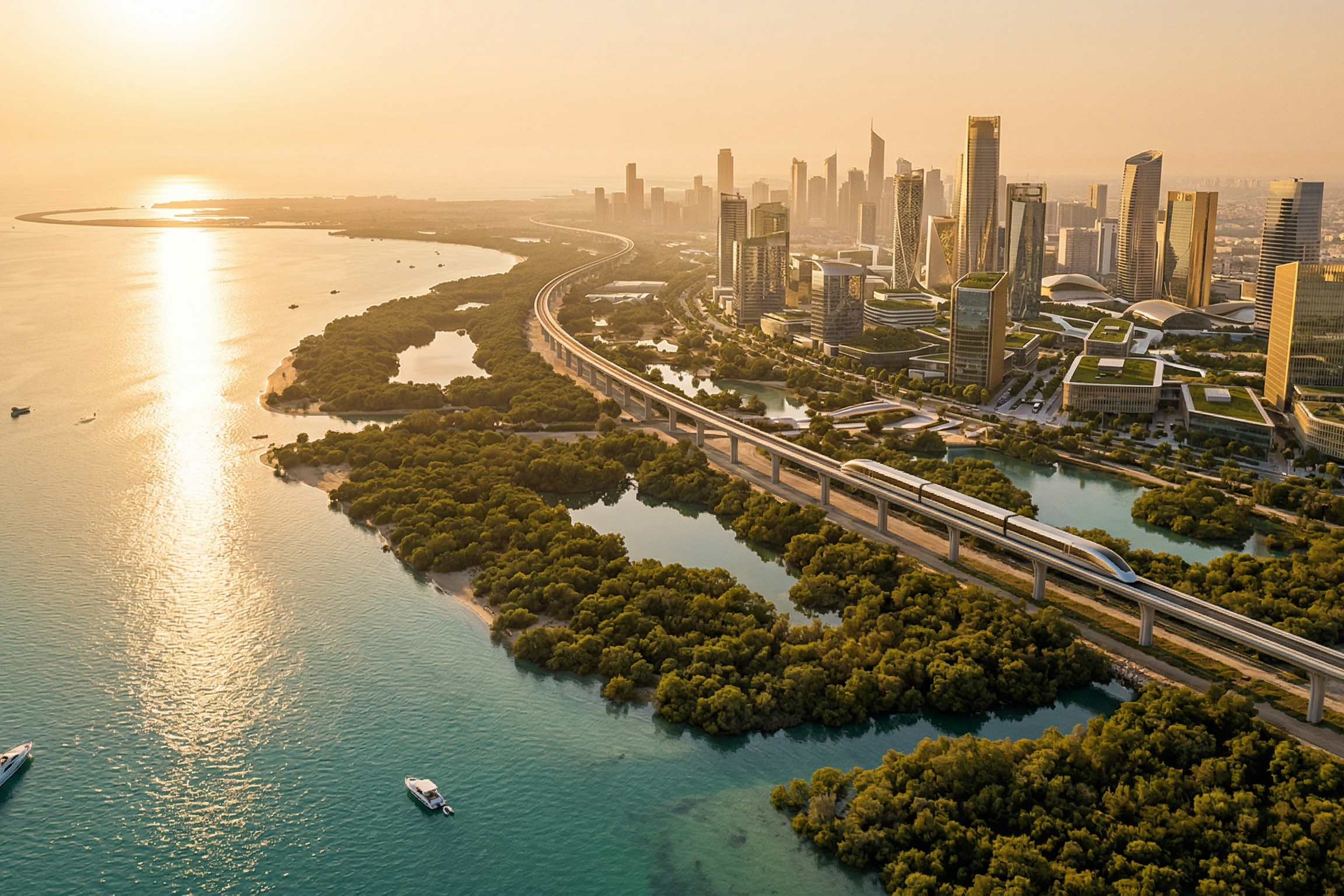
The flagship infrastructure project of the MEU is the Perso-Arabian Ring, a high-speed maglev railway loop connecting all eight member states in a continuous circuit around the Gulf. The Ring runs from Qeshm Island through Al Jirrī, Dubai, Abu Dhabi, Dammam, Kuwait City, Shalamcheh, and back along Iran’s southern coast.
The most technically challenging section is the Hormuz Tunnel, a full-bored tunnel connecting Qeshm Island on the Iranian side to the Musandam Peninsula on the Omani side. Construction began in 2047, and the tunnel carried its first passengers in 2053, marking the start of Era IV.
Environmental cooperation is anchored by two initiatives: the Mangrove Belt, a joint Iran-Qatar-Bahrain coastal restoration program, and the Gulf Solar Grid, a cooperative network of solar electricity generation spanning the desert regions of all eight member states.
Governance
The MEU operates through a rotating presidency, with each member state holding the chair for a two-year term. The administrative body, the Gulf Secretariat, is permanently based in Muscat. Legislative decisions require a supermajority of six out of eight members. A directly elected Gulf Parliament provides legislative input on economic and infrastructure policy.
The union does not have a single capital city. This was a deliberate design choice to prevent any one nation from dominating the institution. Major summits rotate between member capitals.
The MEU’s founding charter incorporates the Seven Principles (decentralization, democratization, open source, transparency, modularity, repairability, upgradeability) as minimum standards for member-state governance. This does not mandate identical political systems, but it establishes a baseline for democratic participation, fiscal transparency, and institutional openness.
The MEU Flag
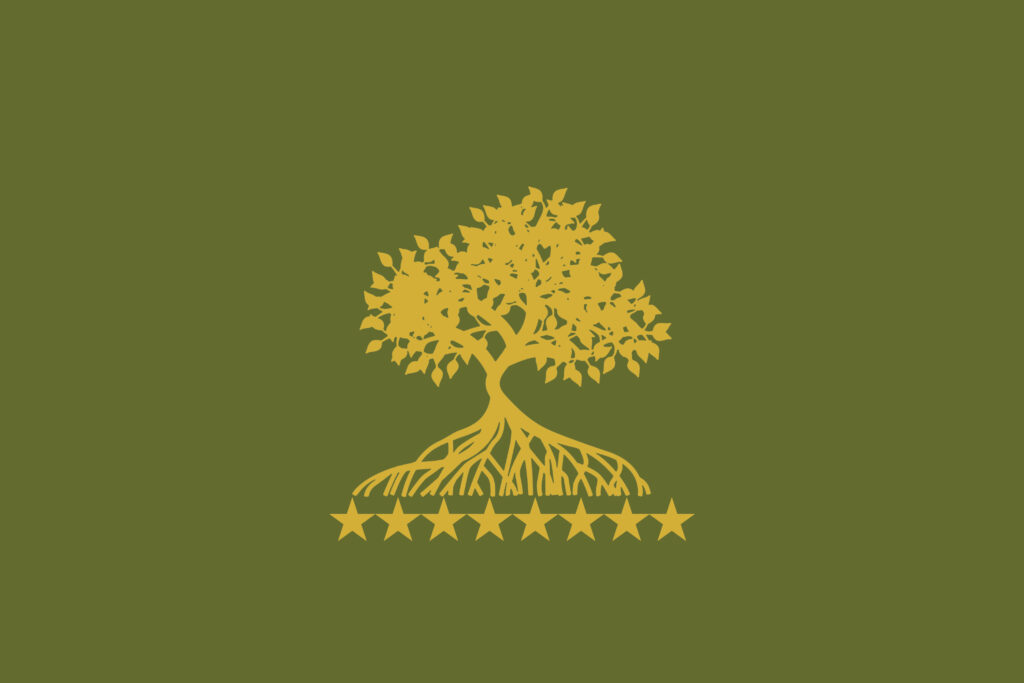
The MEU flag features a mangrove tree in gold on an olive-green field, with eight stars beneath the root system representing the initial eight member states. The mangrove symbolizes resilience, coastal protection, and the intertwining of roots across borders. The olive-green references the Gulf’s aspiration toward environmental restoration.
Relations with the European Federation
The MEU and the European Federation maintain extensive economic and diplomatic ties. The two blocs coordinate on green energy corridors (particularly hydrogen and solar electricity pipelines from the Gulf to Europe), maritime security in the Red Sea and Mediterranean, and climate research through the Climate-Ark Initiative. The Anatolian Maglev Corridor physically connects the two rail networks through Turkey.
The relationship is cooperative but not without friction. The EF tends toward slower, more deliberative policy-making, while the MEU favors rapid infrastructure deployment.
Member States
The United Satrapy of Iran is the largest member by population and territory. Its transformation from theocracy to secular federal state was the political precondition for the MEU’s existence. The Sultanate of Oman played the role of diplomatic broker, continuing its tradition of quiet mediation. The United Arab Emirates contributed the most advanced existing infrastructure and the economic model that influenced the Ring’s financing structure. Saudi Arabia, the largest member by land area, anchors the western arc of the Ring and hosts the Mecca to Mashhad corridor.
Qatar, Bahrain, Kuwait, and Iraq each brought distinct strengths: Qatar’s energy expertise and media reach, Bahrain’s banking infrastructure, Kuwait’s sovereign wealth, and Iraq’s agricultural potential in the Tigris-Euphrates basin through the Cradle of Humanity initiative.
See also: Perso-Arabian Gulf · Perso-Arabian Ring · Strait of Hormuz · United Satrapy of Iran · Hormuz Tunnel · Treaty of Muscat
Flag
Founded
2041 (Treaty of Muscat)
Members
8 nations
Capital
Rotating presidency
Population
~380 million
Area
~5.4 million km²
Currency
Gulf Rial