Thread
The first Tale
The onions have to be thin. That’s the thing nobody tells you. Not diced, not chopped, not whatever you think “sliced” means. Thin. Long and thin. Like you’re trying to make them disappear into the sauce and leave nothing behind but flavor.
I’m explaining this to her, who is holding half an onion like it personally offended her.
“How thin?”
“Thinner.”
“How thin is thinner?”
“You’ll know when you see it.”
She gives me a look. Sami is a systems engineer. She designs water treatment plants. She needs numbers. She needs specs. I’ve known her for three years now and I still can’t get her to understand that some things don’t have specs.
“Five centimeters long,” I say, because I love her and I don’t want her to suffer. “Thin as you can manage. Same shape as the carrots and the orange peel later. Everything should look like it belongs together.”
She nods. This she can work with.
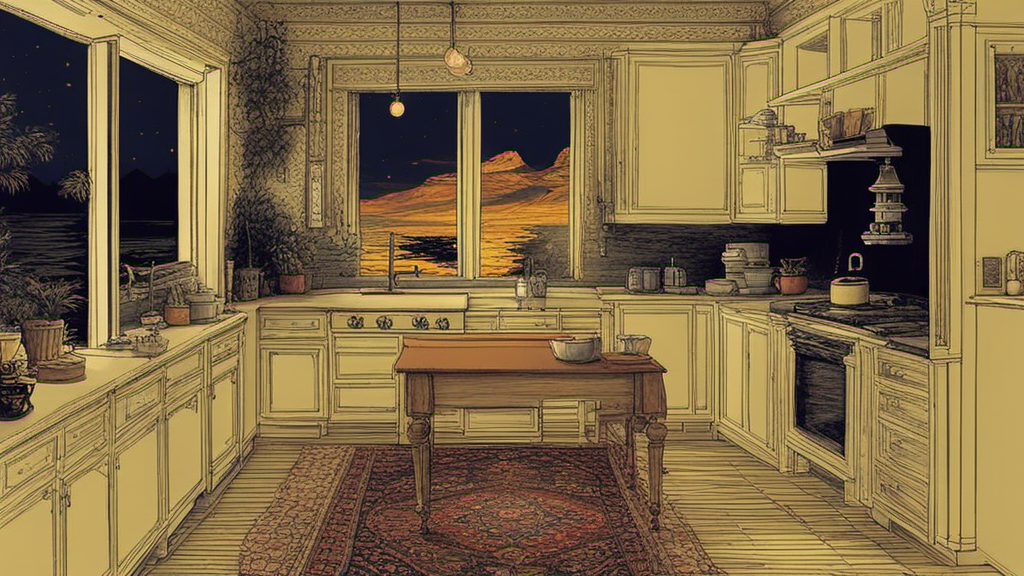
Darius is on the balcony with Tomas, arguing about football. I can hear them through the open door. Something about a goalkeeper. Darius thinks the save was luck. Tomas insists it was positioning. They’ve been having variations of this argument since I moved here, which was four months ago. The kitchen is the only room I set up properly. I still have boxes in the bedroom. But the kitchen has everything where it needs to be, because the kitchen is the room where life actually happens.
“When did you learn this?” Sami asks.
“My mother.”
“In Tehran?”
“Her kitchen was smaller than this bathroom.”
I don’t tell Sami about that kitchen. Not because it’s painful but because it would take too long and the onions are ready.
“Push them aside. Don’t take them out. Same pan.”
“Why?”
“Because the chicken needs to meet the onions where they already live.”
I unwrap the legs. Whole legs, skin on. This isn’t a recipe for people who are afraid of bones or fat or mess. You want clean, go eat a salad.
“Skin side down. Don’t move them.”
“For how long?”
“Until they tell you.”
“The chickens are going to tell me.”
“The pan is going to tell you. When the skin releases, it’s ready. If you have to pull, it’s not.”
She places the legs carefully, like she’s laying tiles. The sizzle fills the kitchen and Darius leans in from the balcony.
“Is that the orange chicken?”
“Not yet.”
“Tell me when it’s the orange chicken.”
“You’ll know.”
Tomas comes inside and opens the fridge without asking, which means he’s been here enough times. He finds the Doogh I made this morning and pours himself a glass. He’s from Izmir. The first time he tried Doogh he said it was just Ayran with more attitude. I told him Ayran IS Doogh that forgot where it came from. We agreed to disagree. This was before we agreed on most other things.
“Who’s doing the rice?” he asks.
“I’m doing the rice.”
“Can I watch?”
“You can watch.”
The rice is the part that scares people. Everyone thinks it’s about measurement and timing and temperature and they’re not wrong, exactly. But they’re not right either. The rice is about feel. You half-cook it. Not soft, not hard. You bite a grain and it should resist in the center, just barely. Then you drain it with cold water running through to stop the cooking and wash off the extra starch so the grains don’t stick. The pot goes back on the heat. Oil at the bottom. The rice goes in. You make holes with the handle of your spatula, like little chimneys, so the steam can rise from the bottom through the whole thing.
Then the cloth.
“What is that?”
“Damkoni.”
“What does it do?”
“It goes between the pot and the lid. It catches the steam and pushes it back down. The pressure builds inside. The bottom turns into Tahdig.”
“Into what?”
“only THE BEST PAAART!”
My mother’s Tahdig was never the same twice. Some days it was paper-thin and shattered like glass when you hit it with a spoon. Some days it was thick, almost like bread, chewy at the center and golden at the edges. I asked her once why it came out different every time. She said the rice decides. I was twelve. I thought she was joking.
She wasn’t joking.
Samira is watching me layer saffron water over the rice. I brewed it this morning. A pinch of threads in a small cup of hot water, crushed with a sugar cube, left to steep until it turns the color of sunset. Some people use extract. Extract works. But if you have the real thing, use the real thing. Oh! and you put it on an ice cube and let it melt to get an even better aroma (allegedly…)
“How much saffron water?”
“Enough.”
“That’s not a measurement.”
“It is. It’s the only measurement that matters. Enough. Not too much, not too little. Juuust Enough.”
She shakes her head but she’s smiling.

The chicken skin has released. I flip the legs and the undersides are exactly what I want: deep golden, almost caramelized, with dark spots where the fat rendered. The onions around them have gone soft and brown. The kitchen smells like my mother’s kitchen now. It always does at this stage. Doesn’t matter what city, what country, what year. This smell is a fixed point.
Now the orange juice. Plain, no pulp. It goes in and the whole pan screams and the liquid turns muddy and dark as it picks up everything stuck to the bottom. All that fond, all that flavor that everyone thinks is a mistake, that’s the foundation.
“Now the spices. Turmeric. Paprika. A little cinnamon.”
“How much cinnamon?”
“Less than you think. Cinnamon is a guest in this dish, not a resident.”
“What about chili?”
“I use Turkish flakes. Tomas brought me a bag last month. They’re perfect for this. Warm, not aggressive.”
Tomas raises his Doogh glass from the couch in acknowledgment.
The juice reduces. I add more. It reduces again. This is the patience part. The chicken is cooking slowly in the orange and the spices and the onion and its own rendered fat, and there is nothing to do now but wait and occasionally tilt the pan.
Darius has come back inside. He’s sitting on the counter, which I’ve told him not to do, and he’s telling a story about a client who wanted a rooftop garden on a building that doesn’t have a rooftop. Sami is laughing. Tomas is googling whether this is architecturally possible. It is, apparently, but it would cost more than the building.
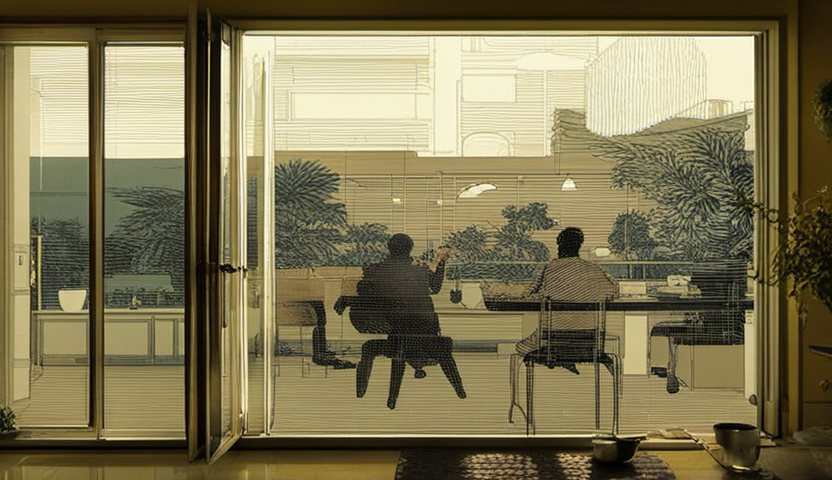
This is the part I didn’t know I was building toward. Not the food. The room. The people in the room. The fact that four people from three different countries can sit in a kitchen on this coastline and argue about rooftop gardens while chicken cooks in orange juice. This was not available to me before.
Outside, something hums past the balcony. A small buzz, there and gone.
Dariush stops talking.
It’s nothing. A municipal drone. Environmental monitoring, maybe, or traffic. They pass every few minutes. Part of the furniture. But Dariush’s hand is flat on the counter and his eyes are somewhere else for a moment. Just a moment.
Tomas, without looking up from his phone, reaches over and puts a glass of water next to Dariush’s hand.
Samira says, “The onions look like they’re burning.”
They’re not burning. She knows they’re not burning. But it gives Dariush a reason to look at something, to be here, and he takes it.
“They’re fine,” he says. “I’ve seen worse.”
He picks up his tea. His hand is steady. He takes a sip and looks at me and there is something in his face that is not pain exactly but the place where pain used to be, and we do not talk about it because we don’t need to. We were all there. Not in the same place, not in the same way, but we were all there.
“Tell me about the topping,” Samira says.
“Butter in a clean pan. Carrot slices first.”
“Same shape as the onions?”
“Same shape as the onions. You’re learning.”
The carrots go in and the butter foams around them and the color shifts from raw orange to something warmer, something richer. When they’re about eighty percent done, which means they bend slightly but still have spine, you add a pinch of sugar. Then the orange peel slices. Then the barberries.
“Now listen. From this moment it needs your full attention. Barberries burn faster than anything you’ve ever cooked. They go from perfect to ruined in thirty seconds. Stay with them.”
Samira stands over the pan like she’s monitoring a reactor. I love this about her. She gives everything the same intensity. Water treatment plants. Barberries. Everything deserves precision.
The barberries swell in the butter. They go from dried and wrinkled to fat and glossy and the color deepens from dusty red to something like garnet. The orange peel curls. The carrots glaze. The sugar catches and just barely begins to caramelize.
“Now. Off the heat.”
She moves the pan and looks at what she made and there is a moment, just a brief one, where she’s not an engineer looking at a process. She’s just a person looking at something beautiful that she made with her hands.
At the end, I add the pulpy orange juice to the chicken. Not to cook, just to simmer for a few minutes. The pulp gives it texture, something to hold onto, something that reminds you this came from a fruit that grew on a tree in the sun. I don’t know if my mother did this part. I think I added it. I’d like to believe I improved the recipe but I’d never say that to her face.
“Is it time?” Dariush calls.
“It’s time.”
The rice. This is the moment. I place the serving platter upside down on top of the pot, take a breath, and flip.
If you’ve done it right, the rice slides out in one piece, a golden dome of Tahdig on top, the white and saffron rice beneath it, steaming. If you’ve done it wrong, it sticks, and you spend ten minutes scraping and pretending you meant to serve it that way.
Today it slides.
The Tahdig is golden and even and it cracks when I cut into it, and Dariush actually applauds, which is embarrassing but also I’ll be honest: I wanted him to.
To serve: a wedge of Tahdig on each plate. A chicken leg on top, with all the sauce, the reduced orange and onion and spice, spooned generously. Then the topping: a pile of the barberries and carrots and orange peel, scattered across the rice like something between a garnish and a celebration.
Fresh ground pepper. Salt. A wedge of lemon if you want.
I set the platter in the center of the table and the four of us sit and for a moment nobody reaches for anything. Not because of ceremony. Because it looks good and it smells good and sometimes you want to just look at a thing for a second before it changes.
Tomas takes a photo. Samira serves herself first, which I told her to do because she did the hard work. Dariush piles his plate absurdly high and grins at me like he’s gotten away with something.
“So,” Samira says, chewing. “I have a question.”
“Go ahead.”
“The recipe. You said you learned it from your mother.”
“I did.”
“And she learned it from her mother?”
“Probably. I never asked.”
“And you changed it.”
“I PERFECTED it.”
“Fine. You improved it. Does she know?”
“God, no.”
“So the recipe moves. It changes hands and it changes.”
“That’s what recipes do.”
“That’s what everything does.”
She says it plainly, like she’s describing a system. Which I suppose she is. She goes back to eating. Outside the window the light is going and the coastline is turning into a line of small lights, and somewhere below us a train arrives or departs, I can’t tell which from here, and Dariush is telling another story, and Tomas is laughing, and the barberries are sweet and tart and the Tahdig is crisp and the chicken falls apart when you look at it.
I think about my mother’s kitchen. The small one. The one with the window that looked out at nothing. She made this dish with less than I have. Fewer ingredients, fewer tools, a smaller stove, a heavier pot. She made it better than I make it. She’ll always make it better than I make it. But she’d like this table tonight. She’d like these people. She’d look at Samira and say “that one understands.” She’d fill Dariush’s plate without asking. She’d argue with Tomas about Doogh versus Aryan and she’d win.
“It’s good,” Dariush says quietly.
“I know.”
“No. I mean. It’s good.”
I know what he means. He doesn’t mean the food.
Fresh ground salt and pepper are added at the end, when serving.
That’s what my mother said.
At the end, when serving. Not before. Never before. You don’t season the process. You season the result.
I used to think she was talking about cooking.
Saturday, March 14th, 2054
Shib Deraz
First of the many kitchen gatherings at my new home.
P.S. That’s a funny name for a town, makes me chuckle every time! I wonder how long that’s gonna last…